

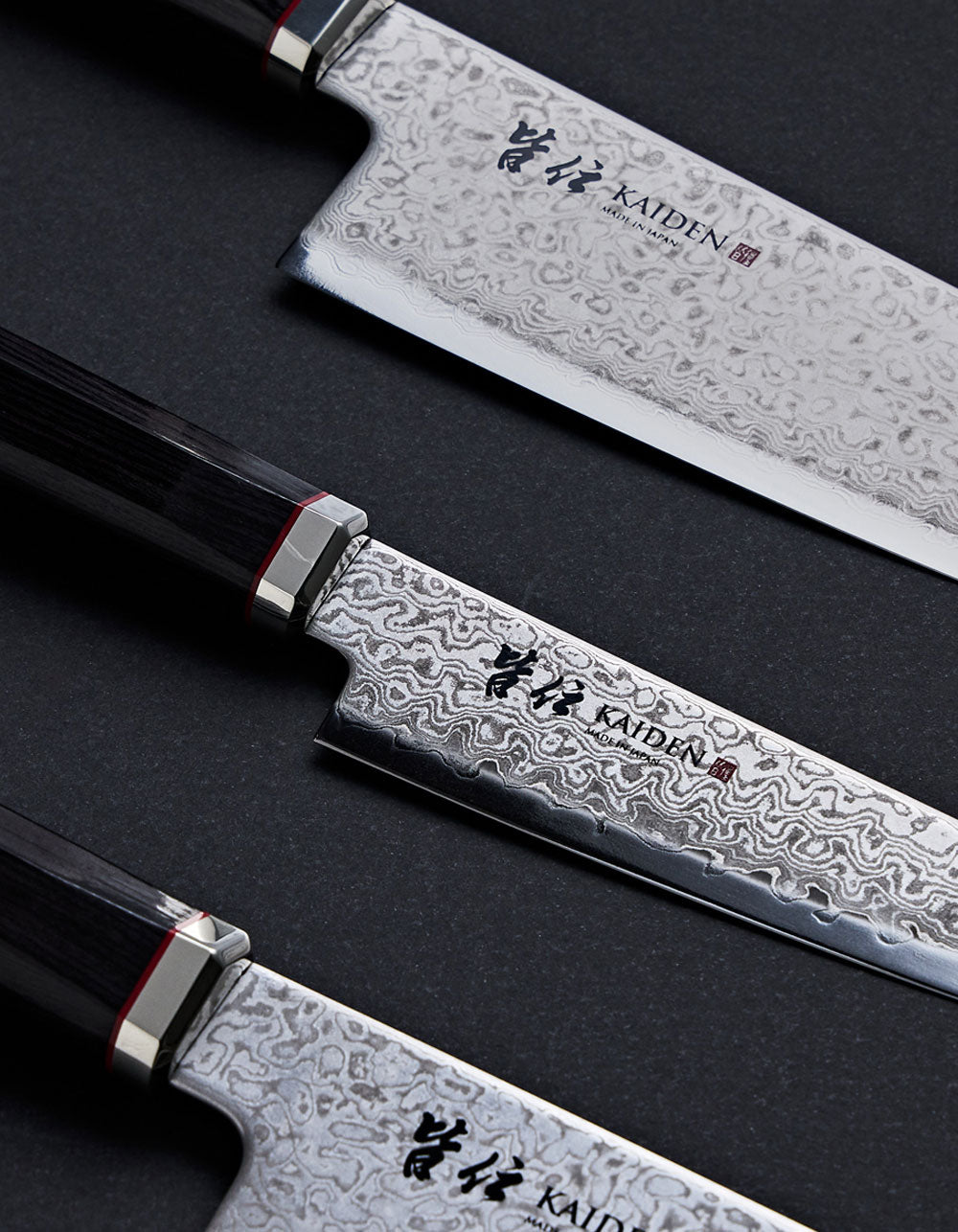
Product Line Up

Knife Sharpening Tips

Knife Sharpening - An introduction

In a perfect world we would all have time to spend 5-10 minutes everyday (or every week for home chefs) to sharpen our kitchen knives to a razor's edge on a Japanese waterstone. This is in fact how the very best Japanese or French chefs finish their shifts – They sharpen their knives religiously at the end of each day. Remember the best time to sharpen your knife is when it’s still sharp. If you wait until it’s blunt, it will take much greater effort and time.

A sharp knife is important in order to preserve the true flavours of fresh ingredients. Cutting with a dull knife will damage food on a cellular level and alter it's taste and appearance. The quality of the cut is becoming an increasingly important issue in professional cooking.

A sharp knife is also important for safety. A dull knife is more prone to slip on food and may result in bodily injury. Sharp knives are also important for kitchen efficiency. It will take more time and effort to cut with a dull knife than a sharp knife. Using a sharp knife is also undoubtedly much more enjoyable.


Knife Sharpening Classes

Chef's Armoury offers hands on knife sharpening classes in Sydney and Melbourne. Small class sizes and expert tuition by Leigh Hudson will give you the skills needed to sharpen kitchen knives using Japanese sharpening stones.

Price is $95 for a group lesson and you will need to have a minimum of a 1000 grit stone to participate. If you are excited about getting your hands dirty for a few hours on a Saturday cick here>> Knife sharpening class - SydneyKnife sharpening class - Melbourne.


Knife Sharpening Service

For those that prefer to leave it to the experts, Click here>> for information on the Chef's Armoury knife sharpening service.


Honing with a steel

If you’d rather watch those taped episodes of “Top Gear” than spend time sharpening your knives, then using a steel might be the right option for you. We recommend using a good quality steel that is at least as long as your knife blade. Click here for the Chef's Armoury diamond steel.

Steeling your knives will put tiny micro grooves along the blade that act like teeth to give it some traction during cutting. The steel will also realign any burrs that have formed. This method is widely used by chefs and butchers. However at some stage a stone is required in order to return a knife to a razor sharp edge.

Step 1

Hold the knife by the handle with your cutting hand and the steel vertically upwards with the other.

Step 2

Hold the handle end of the blade against the steel approximately 2cm from the tip of the steel. Set up the blade with a 15° to degree angle to the steel (20° for German or thicker knives and 15° degrees for Japanese or thinner knives).

Step 3

Draw the knife down the steel and towards the tip of the blade with light to medium pressure. Accuracy is more important than speed so take your time to keep the blade at a consistent angle to the steel.

Step 4

Repeat once on the other side of the knife blade with the opposite side of the steel and alternate sides for 5 to 10 strokes or until the blade is sharp.


A few honing tips

  • Move the knife and not the steel

  • Only the edge of your knife should touch the steel, not the side of the blade (you don’t want to put scratches on your blade)

  • Be careful of your hand holding the steel. I have seen many professional chefs cut themselves while steeling their knives

  • When honing on a steel no longer gives results its time to sharpen your knives on a stone

  • If none of this makes sense, go to your local butcher and ask for some advice.

  • If you are not confident keeping a consistent angle on the steel then it’s probably best to send your knives off to be professionally sharpened. Contact us for the Chef’s Armoury Knife Sharpening Service. Postal service also available.

 
Japanese waterstones

Using Japanese waterstones is our preferred method of knife sharpening because it will give a superior edge to your kitchen knives. Although like anything it will require practice to perfect.

The method of sharpening single bevel knives and double bevel knives is different but the tools are the same. All western knives are double edged. The vast majority of Chef’s Armoury knives are also double edged.

We recommend buying 3 different grades of stone:

  1. “Arato” – A rough stone (280 – 600 grit). This stone is used for repairs and creating a new bevel on badly worn knives. Improper use may lead to a weak edge caused by making the edge too thin and sharpening incorrectly at varying inconsistent angles. 

  2. “Nakato” – A medium grade stone (800 – 1200 grit) used for very minor repairs and creating an even burr, which is the first step in sharpening.

  3. “Shiageto” – A superfine stone (1500 – 3000 grit) is used for creating a highly polished edge and removing the coarser scratches left by the medium stone. This is the stone that gives the feeling of smooth & sharp as opposed to just sharp.


Some knife enthusiasts will also buy a finer 5000 - 12000 grit stone but this is unnecessary unless you really love your knives.


Stone prep

  1. Waterstones should first be soaked in cold water before each use. Leave them underwater for about 10-15 minutes or until no more bubbles appear.

  2. Check that your stones are completely flat because a stone that is worn and uneven will never give good results. You can flatten the stones by rubbing any coarser grade waterstone against the stone that you will be using. You can also buy a specific stone fixer / flattener specifically designed for this task.

  3. Put your stone on a flat surface (narrow side facing you) on a stone holder or non slip mat so that it won’t move when you are sharpening.

 
Sharpening double bevel knives

There are a number of different methods for sharpening on waterstones but we will concentrate here on a method most suitable for beginners. Assuming there are no repairs needed and your knife has a basic bevel of sharpness, start with the medium grade stone - nakato. The most important things to remember are 1) technique and 2) keeping a constant correct angle.

Depending on your knife you will need to hold the blade at a 10° to 20° angle to the stone. Rule of thumb is a German knife or a thicker blade requires a 20° angle.  Thinner Japanese blades can go down to 10°, but unless you have a lot of experience with thin blades, a minimum of 15° is recommended.

A smaller angle gives a sharper edge. A greater angle is not as sharp but the blade is less prone to chipping, so think about the purpose for which the knife is used for before deciding on the angle. Remember only very good quality knives with a high HRC (hardness rating) can hold a small angle, so don’t sharpen your Wusthof or Zwillings knives to less than about 18° or it will all end in tears.


Knife Sharpening technique

Now that you have chosen the desired angle, measure the angle with a protractor which you can buy at your local newsagent or stationary shop or if you have a good eye, guess.
If your knife is badly worn or if you need to remove a lot of metal start with an Arato.

Start

Hold the blade at the desired angle to the stone and starting with the tip of the knife at the end of the stone closest to you, push the blade with a firm pressure towards the other end of the stone and back to where you started. Move back and forth overlapping sections of the knife as you go.

Remember to keep a constant angle to the stone.

Keep going until you can feel a burr (rough upturned edge) on the opposite side of the blade to the one you are sharpening.  The burr should appear along the full length of the blade. If it’s not along the full length of the blade, then keep going.

Once you’ve created the burr, turn the blade over and start sharpening the other side using the same angle. The idea is to remove the some amount of metal from both sides of the knife. There should now be an even burr down the first side you sharpened.

If you started using Arato repeat the process with a Nakato.

A:    This picture shows the angle of the knife against the stone. Chef’s Armoury recommends 15° to 20°. (10° produces a very thin edge which can be easily damaged) 

B:     The action of moving the blade along the stone. Concentrate on keeping a precise angle. Take note of the hand positioning.

C:    Shows an enlargement of the burr that is formed during sharpening

D:     Sharpening the other side of the blade. Notice how the hands are positioned.


Next

Move on to a Shiageto and polish both sides of the bevel until you reach the burr. Be careful to use the same bevel as before. The burr will be harder to feel when using the fine stone.

To remove the burr turn the knife over and using light pressure pass over the stone towards the edge of the blade. Some describe this action as "cutting the water from the stone". It may take a couple of passes on each side of the blade to completely remove the burr.


Finishing

Wash your knife with soap and water and dry thoroughly.
Wash the stone under fresh running water and leave on a flat surface to dry.
Wash your hands thoroughly to remove any metal and stone filings.


Knife sharpening video

We will soon have an instructional video on how to sharpen your knives. If you’re interested join our VIP club and you’ll be the first to hear about it.

Privacy Policy | Terms of use

©2007- James Grace Pty Ltd T/A Chef’s Armoury. All rights reserved.